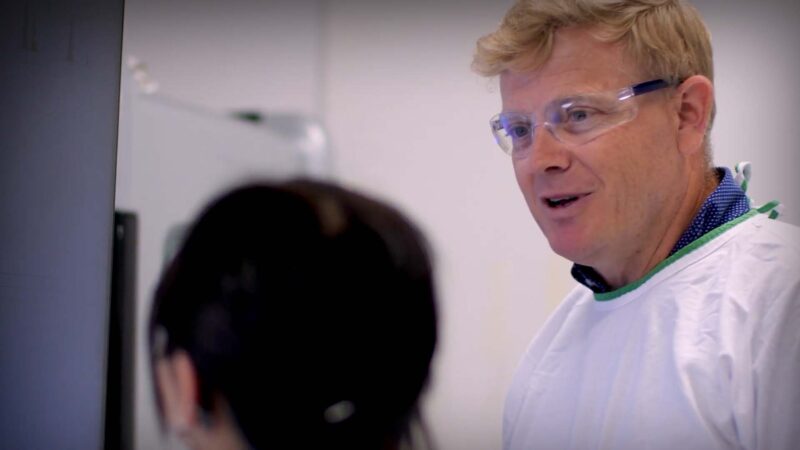
RESEARCHER PROFILE
Professor Stuart Brierley (Filmed February 2024)
Director of the Visceral Pain Research Group,
Director of the Hopwood Centre for Neurobiology &
Theme co-Leader of Lifelong Health
South Australian Health and Medical Research Institute (SAHMRI)
Professor Stuart Brierley is Director of the Visceral Pain Research Group, Director of the Hopwood Centre for Neurobiology, and Theme co-Leader of Lifelong Health at the South Australian Health and Medical Research Institute (SAHMRI).
He has developed a strong track record in coordinating and working in multi-faceted research programs for high impact publications in journals. His work has attracted four NHMRC Fellowships including other NHMRC and NIH grants.
The global pandemic has shed light on the severity of the Opioid Crisis, highlighting the urgent need for effective pain treatments. During his 24 years as a researcher, Professor Brierley has made significant strides in understanding how pain arises from the gastrointestinal tract or the gut.
Prof Brierley is an international expert on the ‘gut-brain axis’ and chronic visceral pain mechanisms. Current investigations are on a individual cell type called the enterochromaffin cell, and it helps signal pain and anxiety from the gastrointestinal tract to the brain.
His research comprises discovery and translational science investigating the nerve pathways innervating visceral organs to determine the causes of, and treatments for, Irritable Bowel Syndrome (IBS), Inflammatory Bowel Disease (IBD), bladder pain syndrome, and endometriosis.
Irritable Bowel Syndrome (IBS) and Inflammatory Bowel Disease (IBD) disorders are highly prevalent, affecting up to 15% of the Western population.
Despite being a major global clinical issue, pain, especially from the gastrointestinal tract, lacks effective treatments, and the research focuses on understanding and treating pain in gastrointestinal diseases in order to develop targeted treatments. Individual gut cells communicate with the brain to signal pain and trigger symptoms that include depression and anxiety.
Professor Brierley is collaborating with researchers in Australia and internationally including Nobel Prize winner Nobel Prize Laureate Professor David Julius, Professor Holly Ingraham and Dr Jim Bayrer at the University of California San Francisco, all with the goal of helping people.
His research interests extends into other common causes for visceral pain including interstitial cystitis/painful bladder syndrome and endometriosis and how ‘cross-organ sensitisation’ can potentially explain co-morbidities in these patients.
Pain is a global issue, and Professor Brierley’s work aims to understand its causes in order to develop targeted treatments, while also balancing a busy family life and various interests.
You Might also like
-
Biomarkers for early sepsis detection
Dr Gabrielle Briggs is a biomedical scientist dedicated to finding smarter, faster ways to diagnose and treat life threatening complications in critically ill patients. Dr Briggs established a research laboratory embedded within the John Hunter Hospital – one of the busiest major trauma centres in NSW. Dr Briggs works alongside surgeons, intensivists, and pathologists to turn complex clinical problems into practical research solutions. Her work spans two major programs: developing a rapid diagnostic test to detect bacterial infections in blood before sepsis takes hold, and exploring mitochondrial transplantation as a novel therapy to rescue injured tissues after trauma and ischaemia.
-
Earlier identification and early intervention for children who are deaf or hard of hearing
Professor Greg Leigh A held a variety of positions in the education of children who are deaf or hard of hearing before entering academia. He holds a degree in Special Education from Griffith University, a Master of Science (Speech and Hearing) from Washington University and a PhD in Special Education from Monash University. In 2001, he was made a Fellow of the Australian College of Educators and in 2014, he was invested as an Officer in the Order of Australia (AO) for distinguished services to the deaf and hard of hearing community.
-
Biological interactions of extracellular vesicles
Raluca Ghebosu graduated from the University of Queensland with a Bachelor of Arts/Bachelor of Science with majors in Japanese and Biomedical Science (2018-2021). She then completed her Bachelor of Science (Honours) with the School of Biomedical Sciences at the University of Queensland in 2022, before pursuing a PhD with A/Prof. Joy Wolfram at the Australian Institute for Bioengineering and Nanotechnology.