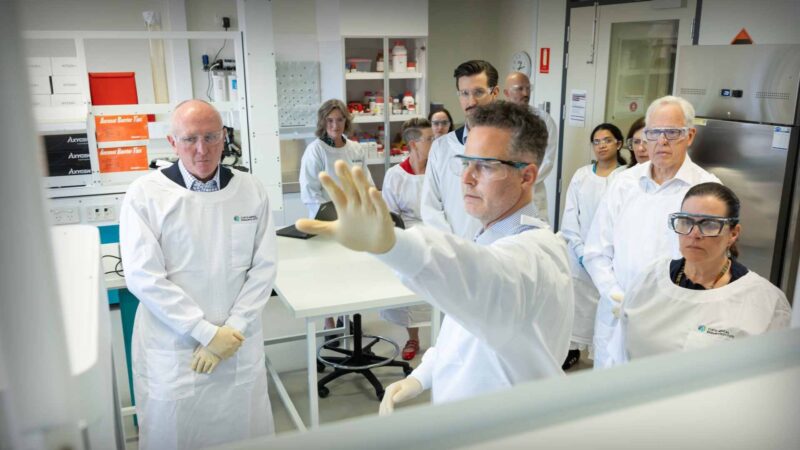
STEM CELL THERAPIES FOR ENTERIC NEUROPATHIES
Dr Lincon Stamp,
Senior Research Fellow & Group Leader,
Department of Anatomy and Physiology,
School of Biomedical Sciences,
The University of Melbourne, Victoria, Australia
RESEARCHER PROFILE
Filmed in Melbourne, Australia | October 2025
Dr Stamp is a Group Leader in the Department of Anatomy and Physiology at the University of Melbourne, Australia. Dr Stamp’s PhD research (with Prof Martin Pera, Monash University) focused on the derivation of hepatopancreatic progenitors from human embryonic stem cells. He then joined the lab of Dr Don Newgreen at the Murdoch Childrens Research Institute where he began working on development of the enteric nervous system (ENS), before joining Prof Heather Young’s lab at the University of Melbourne, where he focused on developing a stem cell therapy to treat gut motility disorders such as the paediatric enteric neuropathy Hirschprung disease.
His lab, which he runs together with Dr Marlene Hao, is now focused on the development, plasticity, and cell and gene therapies for the digestive system, with a particular focus on the enteric nervous system.
Dr Stamp has a strong national and international network of collaborators, including key clinical and consumer connections, and has published high impact studies in top tier journals including Gastroenterology, JCI and Nature Reviews Gastroenterology and Hepatology.
He has had success at securing significant government (ARC, MRFF), philanthropic (NSCFA, REACH Foundation) and industry (Takeda Pharmaceuticals) funding, has strong ties within the Australian and international stem cell communities, and is the currently the President of the Australasian Society for Stem Cell Research (ASSCR).
Source: Supplied
You Might also like
-
Dr Zarina Greenberg
RESEARCH IN BRAIN COMPUTER INTERFACE
@ SYNCHRON
MELBOURNE, VICTORIA, AUSTRALIA -
Impact of Leukaemia Foundation’s Research Funding into Blood Cancer
Bill Stavreski is the Head of Research at the Leukaemia Foundation who talks about the research impact in recent years. The Foundation itself marks its 25th anniversary in 2025, having funded a wide range of health and medical research since 2000. With a focus on basic science, health services research, treatment, and care, the organisation has invested nearly $90 million (adjusted in current dollars terms) in approximately 370 research grants over the years.
-
Liver cancer & patient-derived tumour organoids
Dr Benjamin Dwyer is a translational cancer researcher driven by a clear purpose: to ensure discoveries made in the laboratory genuinely improve outcomes for patients.
Based at Curtin University, he established and now leads the organoid platform within the Liver Cancer Collaborative and directs the WA Organoid Innovation Hub, working at the intersection of biology, medicine and biotechnology to accelerate new treatments for liver cancer.

https://orcid.org/0000-0002-8925-7894