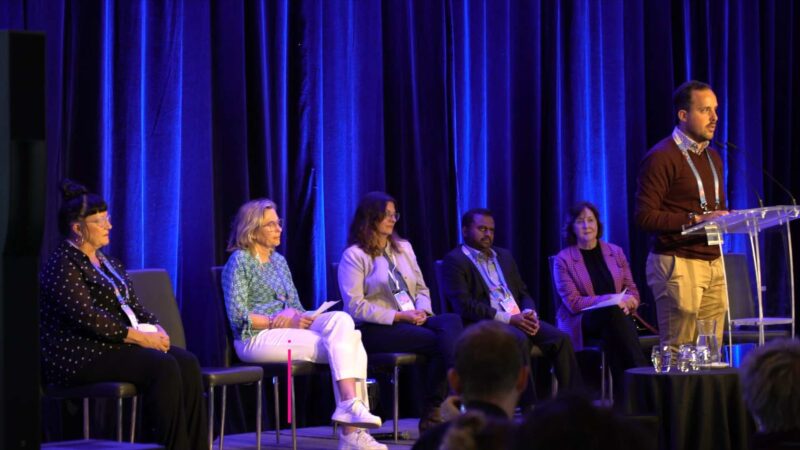
ACHIEVING IMPACT USING OCCUPATIONAL THERAPY IN EDUCATION, FOR MARGINALISED COMMUNITIES AND IN PUBLIC HEALTH
With
Associate Professor Emma George, Program Director, Occupational Therapy
School of Allied Health Science and Practice,
The University of Adelaide &
Board Director, Occupational Therapy Australia &
Australian Delegate, World Federation of Occupational Therapists
PEOPLE IN HEALTH CARE SEGMENT
Filmed in Adelaide | June 2025
Associate Professor Emma George is a leader in occupational therapy, fascinated by the role and importance of occupation as a right for health and well-being. Her research projects all explore the way we address health inequities among marginalised people and communities with a commitment to social and occupational justice.
She has led and collaborated in research on national policy implementation, the health and well-being of Aboriginal and Torres Strait Islander people and communities, and the recovery from exploitation and modern slavery in Australia and India.
In all of her research she am committed to learning more about occupational injustices (marginalisation, alienation, deprivation, imbalance, apartheid and dysfunction), the recognition and realisation of rights, and the response of allied health in order to promote equity and justice, culturally safe practice and trauma informed care. She is an Occupational Therapy Australia board director and serves as the elected Australian delegate to the World Federation of Occupational Therapists.
Source: Supplied
You Might also like
-
Student nurse placements in primary health care
With an urgent need to manage increasing rates of chronic disease, an ageing population, and a rapidly-ageing primary health care nurse workforce, Australia desperately needs more primary health care nurses to enter the workforce before the current generation retires and cannot pass on its skills.
Most nurses start their career in a hospital. Historically, it was difficult for universities and tertiary education providers to arrange placements for student nurses in primary health care. However, the APNA Student Nurse Placement Program provides student nurses with a foot in the door to a career in vibrant primary health care settings such as general practice or community health to perform supervised activities.
-
Peak body in child and family services urges prioritising healthcare for kids in care
The Centre for Excellence in Child and Family Welfare (the Centre) is calling on the Australian Government to prioritise healthcare access for children in out-of-home care.
“We have many amazing young people in care with huge potential, but they’re not set up for success,” said Deb Tsorbaris, CEO “Young people and workers tell us that access to health and education assessments is a huge disadvantage.”
-
Reporting on Australian childhood visual impairment: the first 10 years
The Australian Childhood Vision Impairment Register (ACVIR), the first of its kind in Australia, captures uniquely Australian data which is used to improve services for children with vision impairment. The data is also available to researchers who work in the area of eye disease and disorders of vision.