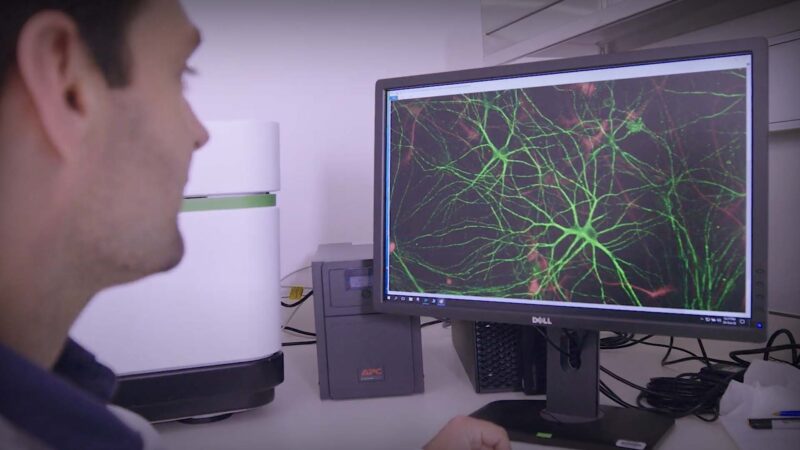
STEM CELL THERAPIES FOR ENTERIC NEUROPATHIES
Dr Lincon Stamp,
Senior Research Fellow & Group Leader,
Department of Anatomy and Physiology,
School of Biomedical Sciences,
The University of Melbourne, Victoria, Australia
RESEARCHER PROFILE
Filmed in Melbourne, Australia | October 2025
Dr Stamp is a Group Leader in the Department of Anatomy and Physiology at the University of Melbourne, Australia. Dr Stamp’s PhD research (with Prof Martin Pera, Monash University) focused on the derivation of hepatopancreatic progenitors from human embryonic stem cells. He then joined the lab of Dr Don Newgreen at the Murdoch Childrens Research Institute where he began working on development of the enteric nervous system (ENS), before joining Prof Heather Young’s lab at the University of Melbourne, where he focused on developing a stem cell therapy to treat gut motility disorders such as the paediatric enteric neuropathy Hirschprung disease.
His lab, which he runs together with Dr Marlene Hao, is now focused on the development, plasticity, and cell and gene therapies for the digestive system, with a particular focus on the enteric nervous system.
Dr Stamp has a strong national and international network of collaborators, including key clinical and consumer connections, and has published high impact studies in top tier journals including Gastroenterology, JCI and Nature Reviews Gastroenterology and Hepatology.
He has had success at securing significant government (ARC, MRFF), philanthropic (NSCFA, REACH Foundation) and industry (Takeda Pharmaceuticals) funding, has strong ties within the Australian and international stem cell communities, and is the currently the President of the Australasian Society for Stem Cell Research (ASSCR).
Source: Supplied
You Might also like
-
Earlier identification and early intervention for children who are deaf or hard of hearing
Professor Greg Leigh A held a variety of positions in the education of children who are deaf or hard of hearing before entering academia. He holds a degree in Special Education from Griffith University, a Master of Science (Speech and Hearing) from Washington University and a PhD in Special Education from Monash University. In 2001, he was made a Fellow of the Australian College of Educators and in 2014, he was invested as an Officer in the Order of Australia (AO) for distinguished services to the deaf and hard of hearing community.
-
Better biomarkers for predicting the incidence of having atherosclerosis and heart attack
Assoc Prof Bursill is a vascular biologist with interests and expertise in vascular inflammation, atherosclerosis and angiogenesis. She completed her PhD at The University of Adelaide in lipid metabolism then headed to Oxford University for five years to undergo a postdoctoral post in the Departments of Cardiovascular Medicine and Pathology. Her postdoctoral time triggered her interest in the mechanisms that cause atherosclerosis and in particular the role of small inflammatory proteins called chemokines.
-
Neuroscience, neuropharmacology and exercise science
Dr Jacob Thorstensen is an early-career Assistant Professor in Neuroscience and Physiology in the Faculty of Health Sciences & Medicine at Bond University. He is also an honorary research fellow in The School of Biomedical Sciences at The University of Queensland. His work has unveiled several new neuroscientific mechanisms which have future applications for movement disorders.
https://orcid.org/0000-0002-8925-7894